The telecommunications industry uses many different fiber optic connectors and with different end face polishes. One of the most common issues our customers face pertains to APC and UPC fiber optic connectors. To help you, we have are providing an overview of each type, as well as a review of common issues in this APC vs. UPC Optical Connectors Guide
Fiber optic connectors have three different end face polishes:
They are PC, UPC and APC. Each one has different reflections performance and thus are used in different applications.
All these fiber optic connectors are “Physical Contact” (PC) connectors meaning that, when they are connected, the fiber end faces actually make contact with each other.
APC Connectors
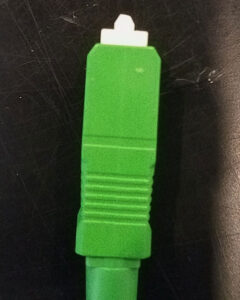
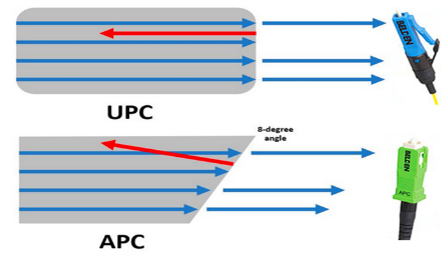
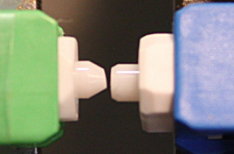
APC stands for Angle Polished Connector, as you can see in this image, the end of the connector is at a slight (8°) angle.
This is why it has better back reflection of more than -60 dB.
This is extremely important in fiber optic systems for RF TV Signal Distribution (HFC) Networks.
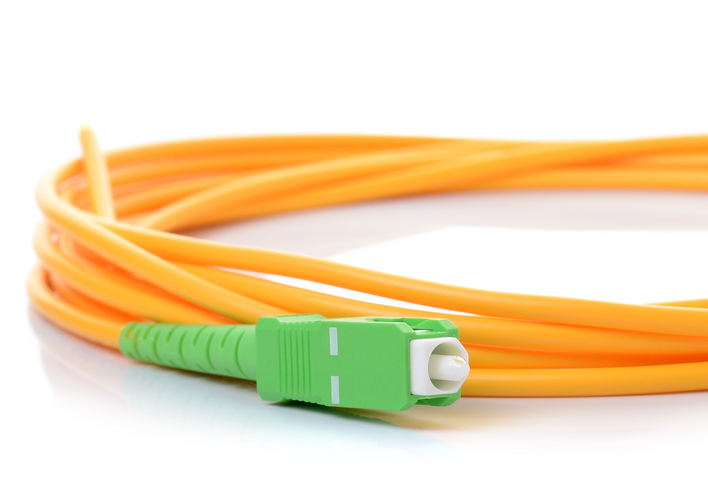
As you can see, the body of the connector is green. All APC connectors have a green body or boot.
UPC and PC Connectors
Connectors with PC and UPC end face polishes are typically used in data networks whereas APC polished connectors are used in broadband (cable TV networks).
These days, the UPC connector is the one mostly used for data networks and the PC is not nearly as popular.
PC and UPC connectors have a blue body or boot. This is an industry wide standard to identify the different polishes used on the connector.
Issues and Challenges
So where do the issues come from? Most often it is customers using a blue connector for a RF Broadband fiber optic distribution system. Why does this cause problems you may ask? In a broadband RF system a high return loss or back reflection connector is required to prevent the reflected signal (light) from returning back to the transmitter and possibly damaging it.
See our illustration of how the light is reflected on the different connectors.
The other issue we commonly run across is mixing UPC and APC connectors in a system.
When this is attempted, it is actually worse as it creates an air gap, resulting in attenuation and a potential for dust acumination.
The bottom line is Green is Good and Blue is Bad in a RF fiber optic system